Loading…
Skip to content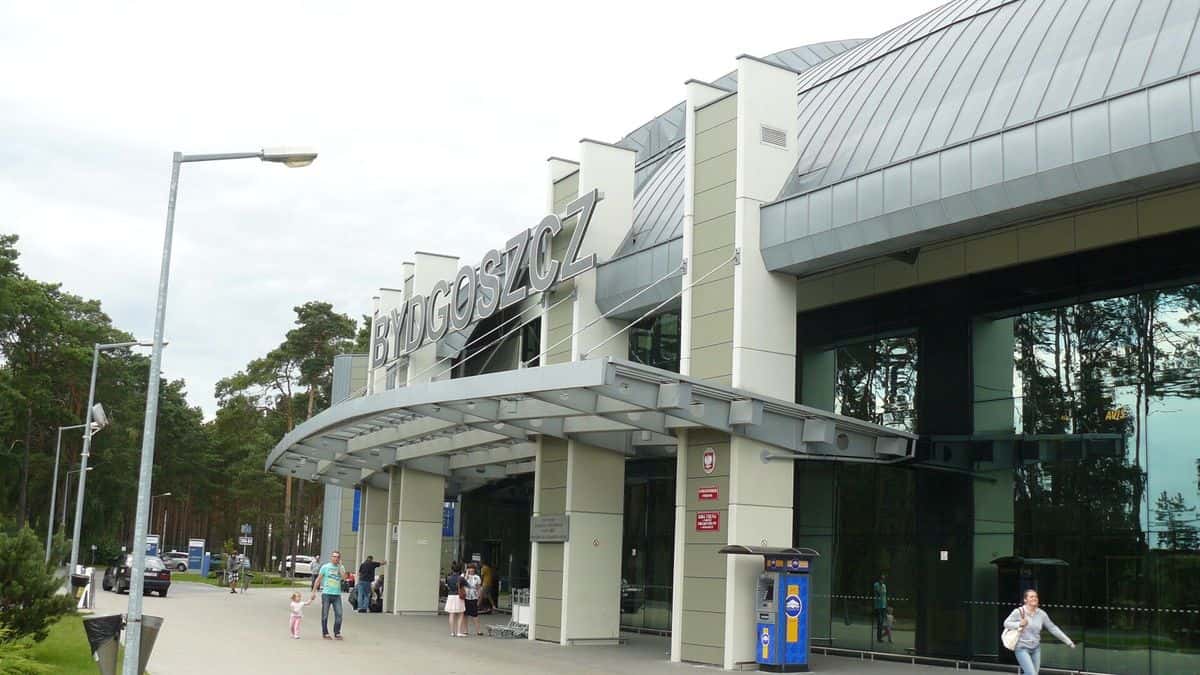
Parking at Bydgoszcz airport
Bydgoszcz airport lies south of the centre, and the car parks stand in the terminal's immediate neighbourhood.
No car parks at Bydgoszcz airport yet
The first car park shows up here once an operator lists it. Directions to the airport are below.
It serves Kuyavia and Pomerania, and the car parks stand in the terminal's immediate neighbourhood.
How to reach Bydgoszcz airport
Driving to Bydgoszcz
Two expressways frame the city. The S5 runs down its western side and the S10 forms the southern ring; they meet at the Bydgoszcz Zachód interchange, where the DK10 and DK80 national roads also join. For the airport you stay on the ring further, as far as the Bydgoszcz Południe interchange, still widely known by its older name Stryszek and signed DK25 and regional road 239.
Road 239 then carries you into town along Jana Pawła II avenue, which passes the airport grounds, and Paderewskiego street branches off it to end at the terminal. The ring arrived in pieces: Bydgoszcz Błonie to Bydgoszcz Południe, 9.1 km, opened on 18 December 2009; Bydgoszcz Zachód to Błonie, 7.2 km, only on 31 December 2020. East of the city the S10 towards Toruń is still under construction, with completion dates running from 2026 into March 2027 for the second carriageway near Toruń.
Bus 80 from Bydgoszcz Główny
If you arrive expecting an airport rail link, there is none, and the airport states it plainly: its own travel pages send passengers to Bydgoszcz Główny railway station, where bus 80 departs from a stop directly in front of the building. The line runs daily with twenty stops in each direction, the airport stop is to the right of the terminal as you come out, and single municipal tickets are sold at the shop in the terminal's public area.
For destinations further out, a commercial coach operator, FLYTRANSFER.PL, connects the airport with Toruń, Włocławek, Ciechocinek and Solec Kujawski, with booking online only, so you cannot turn up and pay on board. The same route works in reverse when someone is collecting you from an arrival.
Arriving at Paderewskiego street
Watch the names: the official S5 and S10 interchange lists contain no interchange called Lotnisko, even though the label has appeared in the trade press. The destination to enter is Paderewskiego street — bus 80 uses the same corridor, so if you know its route you know yours.
The last stretch is a city street running alongside the airport grounds. Long-stay sites here straddle an administrative line: some addresses are still Bydgoszcz, others already the Białe Błota commune. No journey times appear here on purpose: the honest figure changes every time another section of the ring opens.
A terminal close to town
The Bydgoszcz terminal is compact and its forecourt small, so shuttles from the car parks stop practically at the door. Departures and arrivals share the building, and there is no risk of a driver pulling up at the wrong one.
Being close to town means many passengers arrive shortly before check-in. If you are flying in the morning, expect not just the car park but the forecourt itself to fill — a quarter of an hour in hand makes a real difference here.
Picking a site here
There are few sites around Bydgoszcz airport, so the comparison comes down to a handful of offers. That makes everything besides the price matter more: staffed hours, a transfer that runs both ways, and whether the site is fenced.
Stays here run shorter than at the charter airports, because a good share of the flights are business and weekend trips. Over a short stay the daily rate matters less than how quickly you get the car back when you land.
Paying and booking
You pay for the booking online, at the moment you make it. BLIK, a payment card and an instant bank transfer are all accepted, the same methods you know from online shops. None of them costs more than the others, and there is no extra deposit collected at the barrier.
You pay the car park's price, with no booking or service fee. The price shown when you book is the final price for the whole stay. It covers the space and the transfer where the operator includes it in the rate; extra services are your own choice and appear as separate lines on the receipt. Once paid, you get an e-mail confirmation with a booking number, and that is your document on arrival.
Free cancellation runs until the cut-off set by the car park operator. You can see that cut-off on the car park's page before you pay. After a cancellation the money travels back the way it came, to the account or the card used at checkout.
What a secure lot means
"Secure" is a set of specifics, not a slogan. CCTV means cameras covering the bays, not just the gate. Fencing means an enclosed site with a controlled entrance. Lighting decides whether picking your car up at night is pleasant. The operator's policy defines what he answers for and what your own insurance covers, so ask about its scope before you leave the car.
Car keys are a separate question. Some lots ask you to leave them so they can shuffle cars on a tight site, others never touch the vehicle. Both practices are normal, but they differ in consequences: if the keys stay, take your documents and your garage remote out of the car, and leave the glovebox empty.
Getting the car ready
Take out everything valuable or personal: the laptop, documents, chargers, the road-toll device. In winter, top up the battery and switch to winter screen wash, because a car standing in frost for a week starts worse than one driven daily. In summer, park away from direct sun on the dashboard if the lot lets you choose.
Check your car's height if you drive a van, an SUV with a roof box or a bike rack on the roof. Multi-storey car parks at the terminals have a height barrier, and a taller car simply will not fit under it. Open-air lots off the airport grounds usually have no such limit — the car park's page tells you whether it is roofed or open.
Arriving at the car park
On arrival you give your booking number or show the confirmation e-mail. Staff note the registration plate, point you to a bay and, where the lot works that way, take the keys. It pays to enter the plate when booking, because then arriving comes down to the gate opening.
The transfer to the terminal usually leaves right after you park, and you order the return leg by phone once you have your luggage. The number is in the booking confirmation, and it is worth saving it on your phone before you fly, along with the site address — nobody wants to hunt through e-mail after a night landing.
Frequently asked questions
How do I drive to Bydgoszcz airport, and where does the access road start?
Leave the ring road at the Bydgoszcz Południe interchange, which is signed with the DK25 and regional road 239 and still often called Stryszek locally; you reach it from both the S10 and the S5. Road 239 then takes you into the city along Jana Pawła II avenue, which runs past the airport grounds, and Paderewskiego street leads from there to the terminal. Enter Paderewskiego in your satnav, because neither expressway has an interchange officially named Lotnisko.
How far is the airport from central Bydgoszcz and from Toruń?
About three kilometres from the centre of Bydgoszcz. The airport occupies 146 hectares in the south-west of the city, with the Szwederowo and Górzyskowo districts immediately to the north and the Bydgoszcz Forest on the other three sides; the runway is inside the city boundary even though the terminal address is in Białe Błota commune. Toruń is roughly fifty kilometres away. We give no minutes on purpose, since the S10 between the two cities is still being built.
Is there a train or an airport station at the terminal?
No. There is no passenger station or halt on the airport site, and the only railway there is the Lotnisko Bydgoszcz freight siding, which leaves line 131 at Trzciniec station. The passenger spur planned under the BiT-City programme, 4.3 to 5 km at a cost of 63 million złoty, was shelved in 2011 over expected low demand and never built. In practice the rail option means Bydgoszcz Główny station plus bus 80, which the airport times at about fifteen minutes to the centre.
Where do arrivals come out, and where does a driver wait for them?
A single terminal handles both arrivals and departures, so there is no chance of waiting at the wrong building, and passengers walk in from the apron rather than through an air bridge. The bus stop is on the right-hand side of the terminal as you exit, and Paderewskiego street is the access road in and out by car. Allow more time in July and August: the building is working close to its design capacity of 500,000 passengers a year.
Is it worth leaving a car here for two weeks, or flying from a larger airport?
Two weeks is the typical stay here, because the summer peak is charter traffic: Antalya from 24 April at up to eight rotations a week, plus Crete, Rhodes, Majorca and Egypt. Against that, the scheduled network is seven routes, while Gdańsk and Poznań offer far more for a longer drive. Older catchment studies found that Toruń residents had no clear preference among the competing airports. If a Bydgoszcz departure time suits you, the short approach wins.