Loading…
Skip to content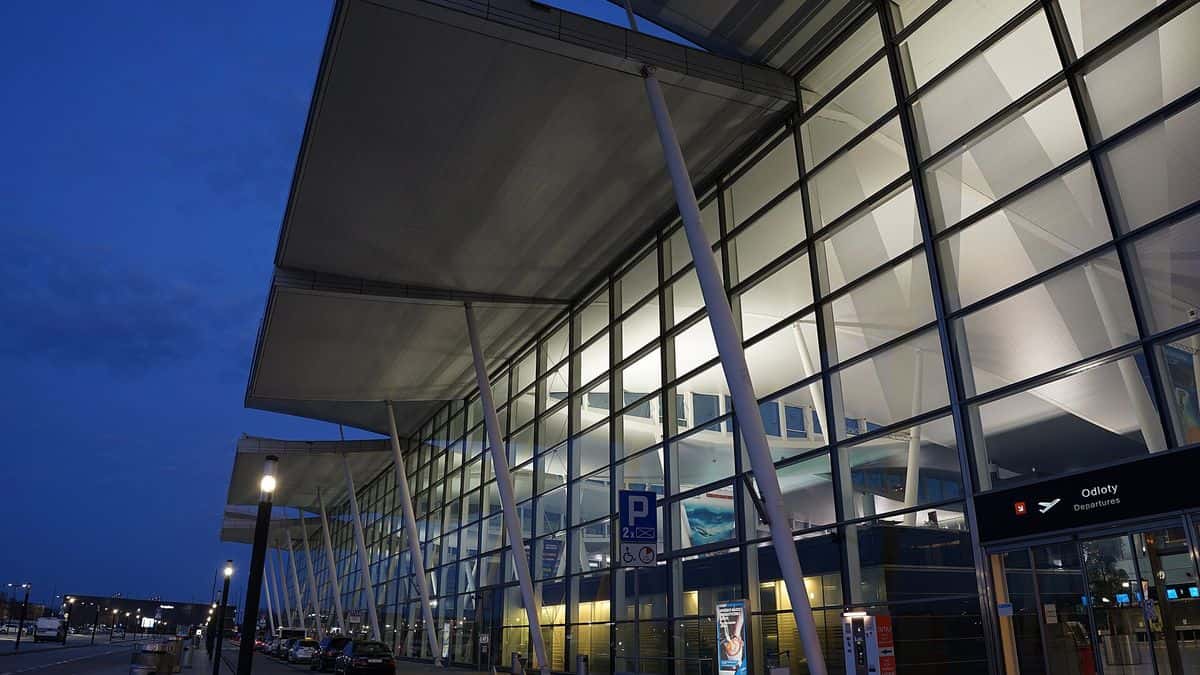
Parking at Wrocław airport
No dates selected
We have no car parks here yet. Look at the nearest airports below.
Strachowice hangs off the Wrocław ring road, and the lots stand along the same approach as the terminal.
No car parks at this airport yet
We are working on it. Have a look at car parks near other airports — we cover every airport in the country.
Wrocław-Strachowice (WRO) sits on the western edge of the city and serves Lower Silesia plus a fair share of traffic from Opole and Greater Poland. Getting there is straightforward, because the airport hangs off the ring road and the lots stand along the same approach. Three things matter to anyone parking: where the shuttle stops, when it gets tight, and whether standing at the terminal is worth it. Below are the car parks around Strachowice.
How to reach Wrocław airport
Driving to Strachowice
The A8, known locally as the Autostradowa Obwodnica Wrocławia, curves around the western side of the city and carries its own Wrocław Lotnisko junction, between the Wrocław Zachód and Wrocław Stadion exits. From there it is a short run along Graniczna to number 190, so reaching the airport never involves the old town.
The A8 is the shortest motorway in Poland at 22.722 km and opened in full on 31 August 2011. It gathers traffic from the A4 (E40), the S8 (E67), the S5 (E261) and national road 5, and the airport describes itself as connected to the A4 and A8 motorways and the S3, S5 and S8 expressways. The route is therefore chosen well before the city rather than inside it.
Buses 106, 129 and 206
There is no railway to the terminal, so ordinary city buses do the shuttle job. Line 106 links the terminal with Wrocław Główny railway station and the central coach station, running through Renoma, Dworzec Świebodzki, the industrial park, Nowy Dwór and Strachowice. Line 129 comes in from the northern districts, starting at Poświęcka, line 206 covers the night, and FlixBus coaches on the Szczecin to Zakopane route call at the Wrocław Lotnisko stop.
Infrastructure for a future rail link was built with the terminal — a tunnel underneath it and a road viaduct over the planned alignment — but no start date has ever been given. Access stays on the road.
Arriving at Graniczna 190
The terminal stands at Graniczna 190 in the Strachowice district, on the south-western edge of Wrocław, roughly 10 km from the centre. The last stretch is a single local road, and airport signage only starts beyond the junction.
Check the current arrangement at the terminal before setting off: construction on the airfield periodically changes how the kerbside works. Long-stay sites are spread through Strachowice and the estates beside it — short of the airport zone rather than inside it.
The terminal and its zones
Strachowice has one passenger terminal, with lettered zones laid out in front of it, running from the nearest to the door outwards. The letter tells you both the distance and the rate, so it is worth knowing which one you are talking about when you book.
Shuttles from the private sites stop in a marked bay in front of the hall. You get out a dozen paces from the door, and on the way back you come out of those same doors and turn the same way. It is one of the simpler layouts in the country, but still agree a waiting spot with the crew — the bay can be occupied and the driver will then stop a little further along.
When Strachowice fills up
Wrocław flies steadily all year, but the peak is in summer, with a second one around Christmas and New Year. In those windows the lots around the airport fill days in advance, and since the typical stay is long — a week or more — spaces free up slowly.
Outside the peak you will find a space without booking, though the choice of sites and extras will be narrower. If you want something specific, a space under a roof or a charger, book ahead whatever the time of year — there are simply few of them.
Airport zone or private site
The zones at the terminal carry two tariffs, one at the barrier and one for booking online. The barrier tariff is the higher of the two, and it is the one that applies if you simply drive up. For a short stop the gap is bearable, since you walk in and wait for nobody.
For a week away the off-airport sites drop clearly below the terminal rate, and that is their whole advantage — plus staff who will take the car at any hour. Choosing between them, look past the rate at whether the shuttle is included and whether it runs both ways.
Paying and booking
You pay for the booking online, at the moment you make it. BLIK, a payment card and an instant bank transfer are all accepted, the same methods you know from online shops. None of them costs more than the others, and there is no extra deposit collected at the barrier.
You pay the car park's price, with no booking or service fee. The price shown when you book is the final price for the whole stay. It covers the space and the transfer where the operator includes it in the rate; extra services are your own choice and appear as separate lines on the receipt. Once paid, you get an e-mail confirmation with a booking number, and that is your document on arrival.
Free cancellation runs until the cut-off set by the car park operator. You can see that cut-off on the car park's page before you pay. After a cancellation the money travels back the way it came, to the account or the card used at checkout.
What a secure lot means
"Secure" is a set of specifics, not a slogan. CCTV means cameras covering the bays, not just the gate. Fencing means an enclosed site with a controlled entrance. Lighting decides whether picking your car up at night is pleasant. The operator's policy defines what he answers for and what your own insurance covers, so ask about its scope before you leave the car.
Car keys are a separate question. Some lots ask you to leave them so they can shuffle cars on a tight site, others never touch the vehicle. Both practices are normal, but they differ in consequences: if the keys stay, take your documents and your garage remote out of the car, and leave the glovebox empty.
Getting the car ready
Take out everything valuable or personal: the laptop, documents, chargers, the road-toll device. In winter, top up the battery and switch to winter screen wash, because a car standing in frost for a week starts worse than one driven daily. In summer, park away from direct sun on the dashboard if the lot lets you choose.
Check your car's height if you drive a van, an SUV with a roof box or a bike rack on the roof. Multi-storey car parks at the terminals have a height barrier, and a taller car simply will not fit under it. Open-air lots off the airport grounds usually have no such limit — the car park's page tells you whether it is roofed or open.
Arriving at the car park
On arrival you give your booking number or show the confirmation e-mail. Staff note the registration plate, point you to a bay and, where the lot works that way, take the keys. It pays to enter the plate when booking, because then arriving comes down to the gate opening.
The transfer to the terminal usually leaves right after you park, and you order the return leg by phone once you have your luggage. The number is in the booking confirmation, and it is worth saving it on your phone before you fly, along with the site address — nobody wants to hunt through e-mail after a night landing.
Frequently asked questions
How do I get from the airport into central Wrocław?
City bus 106 runs between the terminal and both Wrocław Główny railway station and the central coach station every 15 minutes, covering the whole route in 40 to 50 minutes depending on city traffic. Line 129 serves the northern districts from Poświęcka, and line 206 runs at night.
Is there a train from Wrocław Airport?
No. A rail link has been planned for years and no start date has been given. What exists is preparation: a tunnel under the terminal for the future line and a road viaduct over its planned alignment, both built when the terminal went up. Access remains entirely by road, so plan on a hire car, a taxi or the 106 and 129 city buses.
I have collected a hire car — how do I reach the motorway network?
Leave the terminal along Graniczna and join the A8 ring motorway at the exit named after the airport, which sits between the Wrocław Zachód and Wrocław Stadion junctions. The ring then hands you the A4 (E40), the S5 (E261), the S8 (E67) and national road 5. Times published by the airport: Legnica 40 minutes, Opole an hour, Zielona Góra two hours, Łódź 2 h 10 min.
Where should a driver meeting me wait?
At the single passenger terminal, the 2012 building — all scheduled and charter flights use it, so there is no terminal to confuse. The general aviation terminal is a separate facility with its own stop on the 106 bus route, and not where you meet an airline passenger.
When is this airport busiest?
August, by a wide margin: the 2025 peak month ran about 2.4 times heavier than the January trough. Every month of 2026 so far has run ahead of the same month in 2025, June reaching 631,239. With 22 check-in desks and 8 security lanes in a terminal designed for 3.2 million a year, high summer means queues.
Can I leave a car here for two weeks, and does winter change anything?
Two-week stays are ordinary at an airport whose summer peak is charter-driven. It operates around the clock all year with no local restrictions, and runway 29 has ILS/DME to CAT II, which helps in winter fog. January is the quietest month. For a long stay then, the question is shelter: some sites offer covered bays, others only open ground.
Airports nearby
Warsaw Chopin Airport
20 car parks