Loading…
Skip to content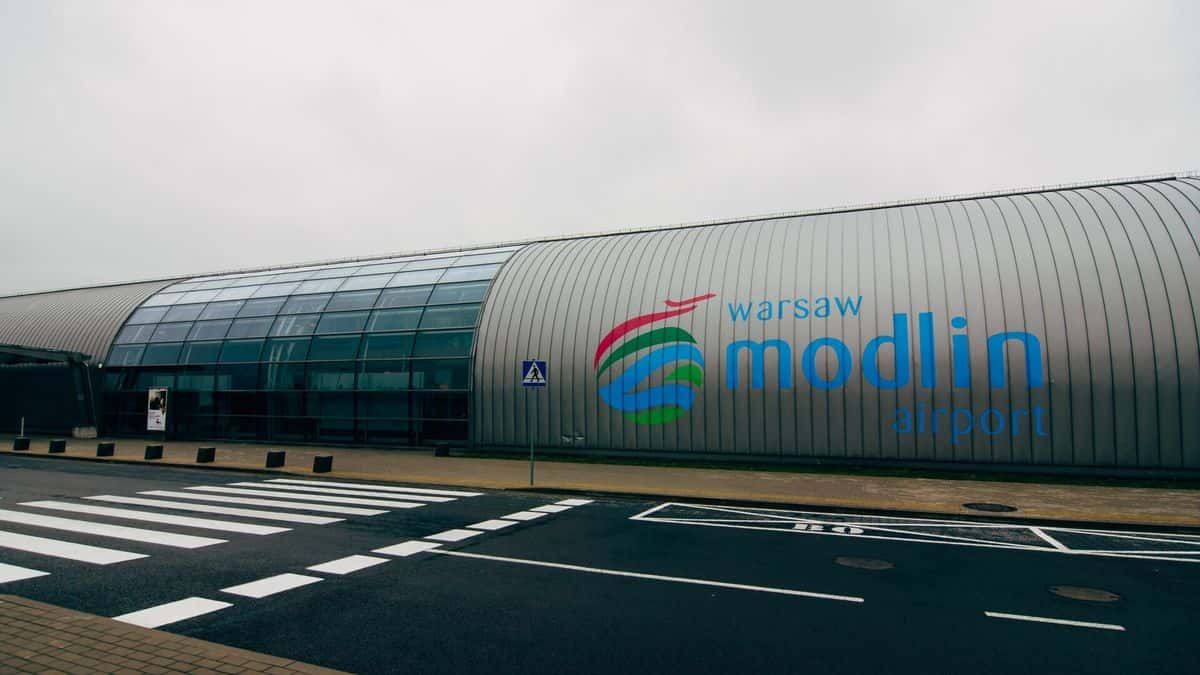
Parking at Warsaw Modlin airport
Modlin sits at Nowy Dwór Mazowiecki, several dozen kilometres beyond Warsaw, along a single approach road.
No car parks at Warsaw Modlin airport yet
The first car park shows up here once an operator lists it. Directions to the airport are below.
For a driver it is a completely different proposition from Okęcie: you drive out of town, the lots stand along the approach road, and how full they are depends on a timetable that shifts from season to season.
How to reach Warsaw Modlin Airport
Driving to Modlin
From Warsaw you take the S7 expressway north and leave it at the Modlin junction, number 56, where the S7 crosses national road 62; road 62 then runs towards Nowy Dwór Mazowiecki and the terminal on ul. gen. Wiktora Thommée. That junction, and no other exit, is the one that serves the airport.
A fresh 9.74 km section of the S7 between Modlin and Czosnów opened on 24 October 2025 and shortened the run from the city side. From the west you join the S7 off the A2 or the S8, and road 62 also ties the airport to national road 61, which carries traffic from Płock and Legionowo.
Train and shuttle to Modlin
Getting here without a car is possible but involves a change. Koleje Mazowieckie and PKP Intercity trains call at Modlin station on line 9 between Warszawa Wschodnia and Gdańsk, leaving 4 km to the terminal, covered by an airport shuttle bus in Koleje Mazowieckie colours; one integrated ticket covers both legs.
Contbus and FlixBus also run direct coaches to Warsaw. The railway is meant to reach the terminal eventually — a spur of about 5.5 km from Modlin station is planned for 2029 — but for now the last few kilometres happen on wheels rather than rails.
Arriving at ul. gen. Thommée
Two names catch drivers out in a satnav. There is a separate Nowy Dwór Mazowiecki junction on the S7, opened on 30 January 2025, which the national road authority does not describe as an airport exit — the airport exit is Modlin. And if you reach Zakroczym, Załuski, Przyborowice, Poczernin or Płońsk Południe, you have overshot.
Set the destination to the terminal street rather than the town, because the airport lies inside the boundaries of Nowy Dwór Mazowiecki, on open ground at the confluence of the Vistula and the Narew. Long-stay sites occupy the built-up strip around ul. gen. Thommée, short of the airport grounds.
A small terminal, short walks
Modlin has one small terminal, and for anyone parking that is its biggest advantage: from where the shuttle drops you to the check-in desk is a few dozen paces. There are no sprawling halls and no choice of entrance — there is one set of doors, and arrivals come out onto the same forecourt.
The consequence is that the pickup point is hard to mistake, but the shuttle bay is small and gets tight at peak. If you land alongside two other flights, call for your transfer as soon as you have your bag rather than once you are outside — the driver will set off before you reach the door.
A low-cost timetable
Modlin runs point to point, with no connecting traffic, so its load is spikier than a large airport's. The departure waves follow one main carrier's schedule, which means that on some days of the week the lots around the airport fill almost to the last space, and on others they stand half empty.
The practical conclusion is that you cannot read the occupancy off what you saw a month ago. Flying out on a Friday or a Sunday in season, book ahead; midweek and off season, the choice will still be wide the day before you leave.
Airport zones and nearby sites
The airport runs its own zones by the terminal, some of them billed as a simple first-day rate plus a flat charge for every started day after. That suits a short trip, because you walk to the terminal and depend on nobody's shuttle.
Over a longer stay the off-airport sites win on rate, and they are usually the ones serving passengers away for a week or more. The ride is short, since nothing around Modlin is far. Do check the transfer's operating hours — Modlin has late arrivals, and a site with nobody on duty at night leaves that problem with you.
Paying and booking
You pay for the booking online, at the moment you make it. BLIK, a payment card and an instant bank transfer are all accepted, the same methods you know from online shops. None of them costs more than the others, and there is no extra deposit collected at the barrier.
You pay the car park's price, with no booking or service fee. The price shown when you book is the final price for the whole stay. It covers the space and the transfer where the operator includes it in the rate; extra services are your own choice and appear as separate lines on the receipt. Once paid, you get an e-mail confirmation with a booking number, and that is your document on arrival.
Free cancellation runs until the cut-off set by the car park operator. You can see that cut-off on the car park's page before you pay. After a cancellation the money travels back the way it came, to the account or the card used at checkout.
What a secure lot means
"Secure" is a set of specifics, not a slogan. CCTV means cameras covering the bays, not just the gate. Fencing means an enclosed site with a controlled entrance. Lighting decides whether picking your car up at night is pleasant. The operator's policy defines what he answers for and what your own insurance covers, so ask about its scope before you leave the car.
Car keys are a separate question. Some lots ask you to leave them so they can shuffle cars on a tight site, others never touch the vehicle. Both practices are normal, but they differ in consequences: if the keys stay, take your documents and your garage remote out of the car, and leave the glovebox empty.
Getting the car ready
Take out everything valuable or personal: the laptop, documents, chargers, the road-toll device. In winter, top up the battery and switch to winter screen wash, because a car standing in frost for a week starts worse than one driven daily. In summer, park away from direct sun on the dashboard if the lot lets you choose.
Check your car's height if you drive a van, an SUV with a roof box or a bike rack on the roof. Multi-storey car parks at the terminals have a height barrier, and a taller car simply will not fit under it. Open-air lots off the airport grounds usually have no such limit — the car park's page tells you whether it is roofed or open.
Arriving at the car park
On arrival you give your booking number or show the confirmation e-mail. Staff note the registration plate, point you to a bay and, where the lot works that way, take the keys. It pays to enter the plate when booking, because then arriving comes down to the gate opening.
The transfer to the terminal usually leaves right after you park, and you order the return leg by phone once you have your luggage. The number is in the booking confirmation, and it is worth saving it on your phone before you fly, along with the site address — nobody wants to hunt through e-mail after a night landing.
Frequently asked questions
How far is Warsaw Modlin Airport from Warsaw, and how do I reach the city?
Around 35 to 40 km, north-west of the centre — this is not an airport you step out of into Warsaw. The rail option stops 4 km short of the terminal, at Modlin on the Warszawa Wschodnia to Gdańsk line, with a Koleje Mazowieckie shuttle covering the gap every 20 to 30 minutes. Centralna to the terminal takes roughly 1 hour 20 minutes in total, so avoid a return leg that depends on the last connection of the evening.
Which junction do I use driving to the terminal?
Number 56, the Modlin junction, signed for road 62. The common mistake is setting a satnav to the town, because a separate junction carries the town's name and does not serve the airport; the address to enter is ul. gen. Wiktora Thommée. Coming from the west, join the S7 off the A2 or the S8 rather than driving through Warsaw, and if the next exits you see are Zakroczym or Załuski, you have gone too far north.
Are there direct coaches into Warsaw, or is the train the only option?
Contbus and FlixBus run direct coaches to Warsaw, quoted at around 45 minutes. The rail route needs one change: a train to Modlin station, then the airport bus for the final 4 km, with a single integrated Koleje Mazowieckie ticket covering both legs. A direct 5.5 km rail spur to the terminal is planned, tendered in 2026 and due in 2029, but it does not exist yet.
Does long-stay parking at Modlin make sense for a two-week trip?
It is the normal pattern here, because the route map is a holiday map: 19 of Ryanair's routes are seasonal, serving Greece, Croatia, Portugal and Spain, so week-long and fortnight trips dominate. Over that length the type of bay matters most — some sites around the airport have covered spaces, others only open-air ones, and the ground beside the runway is exposed in winter.
How early should I be at the terminal in the summer peak?
Allow more time than you would off season. Modlin handles its traffic in one single-storey terminal with six security lanes, and the airport justified building Zone B by pointing at capacity limits in the summer peak with intense low-cost turnarounds. Departures also bunch into early-morning windows, so the first wave in August looks nothing like midday.
Is Modlin the same thing as Warsaw's main airport?
No. Warsaw Chopin is the main airport and sits close to the city, while Modlin is 35 to 40 km out in Nowy Dwór Mazowiecki, and its role is to take low-cost traffic off Chopin rather than to serve as a second airport for the capital. Check the code on your ticket: WMI is Modlin. The two have separate road approaches and separate car parks.